
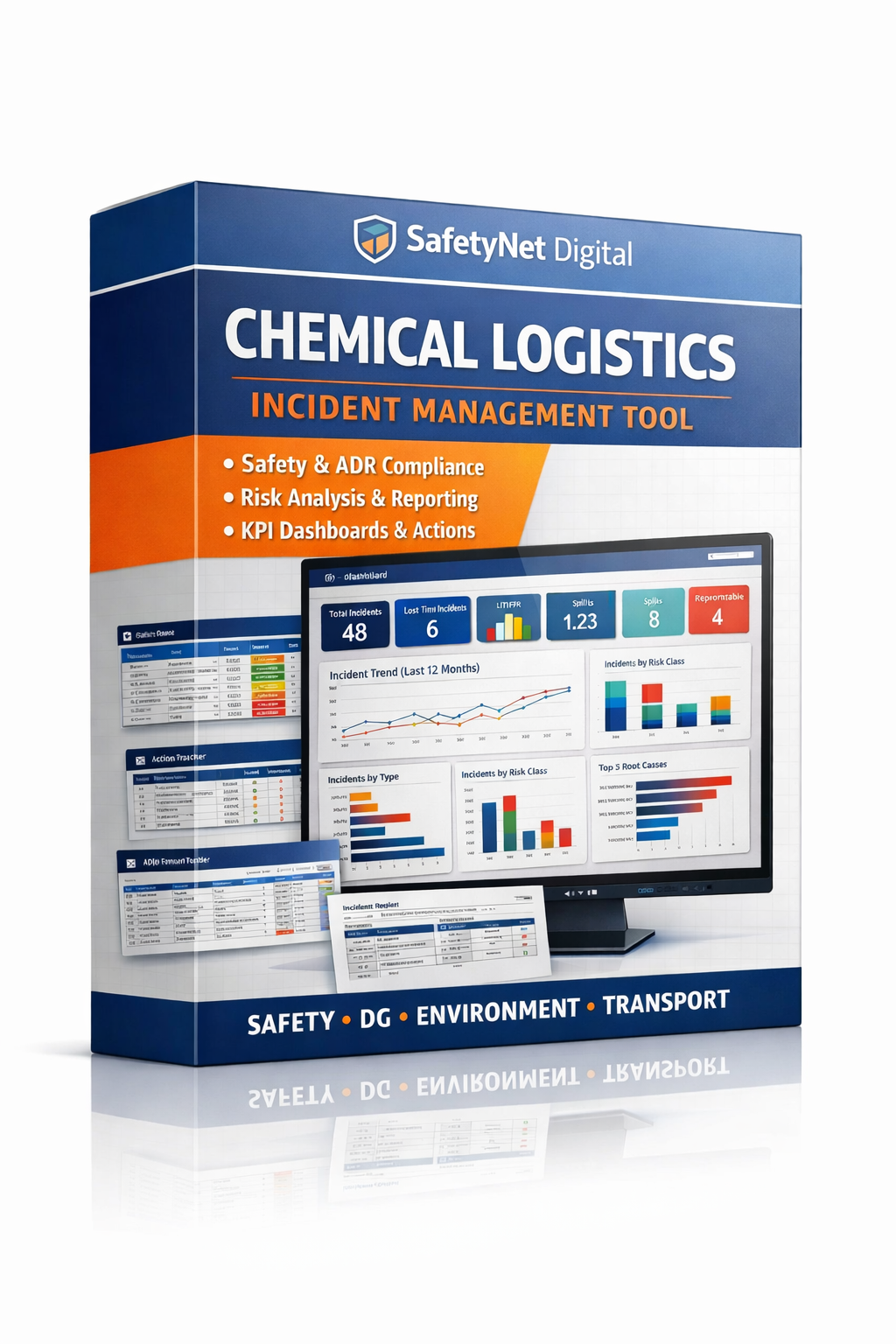
Chemical Logistics Incident & Near Miss Management Tool (EU/UK)
€295,00
Key benefits
- Integrates safety, dangerous goods and environmental incident management
- Reduces time spent on reporting and administration
- Improves visibility and control over risks
- Supports compliance with international standards
- Enables professional, data-driven decision making
Description
Professional Incident Management for Chemical Logistics, Dangerous Goods and Transport Operations
Managing incidents in chemical logistics environments is complex. Companies must deal with a combination of occupational safety risks, dangerous goods regulations, environmental impact and transport-related incidents — often across multiple locations and operational activities.
The Chemical Logistics Incident & Near Miss Management Tool is designed to bring all of these elements together into one structured, practical and highly effective system.
This Excel-based solution enables organisations to register, analyse, manage and report incidents in a way that is aligned with international best practices and regulatory frameworks.
A complete and integrated approach
Unlike standard incident logs or basic spreadsheets, this tool provides a fully integrated incident management system covering:
- Occupational safety (ISO 45001)
- Environmental incidents (ISO 14001)
- Dangerous goods compliance (ADR / IMDG principles)
- Transport and logistics risks
- Management reporting and audit readiness
It allows organisations to move from reactive incident registration to proactive safety and compliance management.
Comprehensive Incident Registration
The tool enables detailed and structured recording of all relevant incident types, including:
- Near misses
- Injuries and Lost Time Incidents (LTI)
- Dangerous goods incidents
- Spills and environmental releases
- Vehicle and transport incidents
- Property damage
- Unsafe acts and unsafe conditions
For chemical logistics operations, additional specialised fields are included:
- UN number and Proper Shipping Name
- ADR class and packing group
- Mode of transport (road, sea, rail, internal)
- Packaging type (drums, IBCs, tanks, containers)
- Spill quantities and product loss
- Authority notification and reportability
This ensures that all incidents can be documented in sufficient detail for both internal analysis and external reporting.
Structured Root Cause Analysis
Understanding why incidents occur is essential for preventing recurrence.
The tool includes a structured approach to root cause analysis, allowing users to classify and analyse:
- Human factors
- Training and competence gaps
- Procedural failures
- Equipment and maintenance issues
- Dangerous goods errors (classification, labeling, documentation)
- Transport-related risks
Each incident can be supported with:
- Immediate cause description
- Underlying cause analysis
- Corrective and preventive actions
This enables organisations to move beyond symptoms and focus on systemic improvements.
Corrective and Preventive Action Management
The integrated Action Tracker allows organisations to:
- Assign corrective actions to responsible persons
- Set deadlines and priorities
- Monitor progress and status
- Identify overdue actions automatically
- Verify effectiveness of implemented measures
This ensures that incidents lead to real improvements, rather than remaining isolated events.
Professional Dashboard and Management Insights
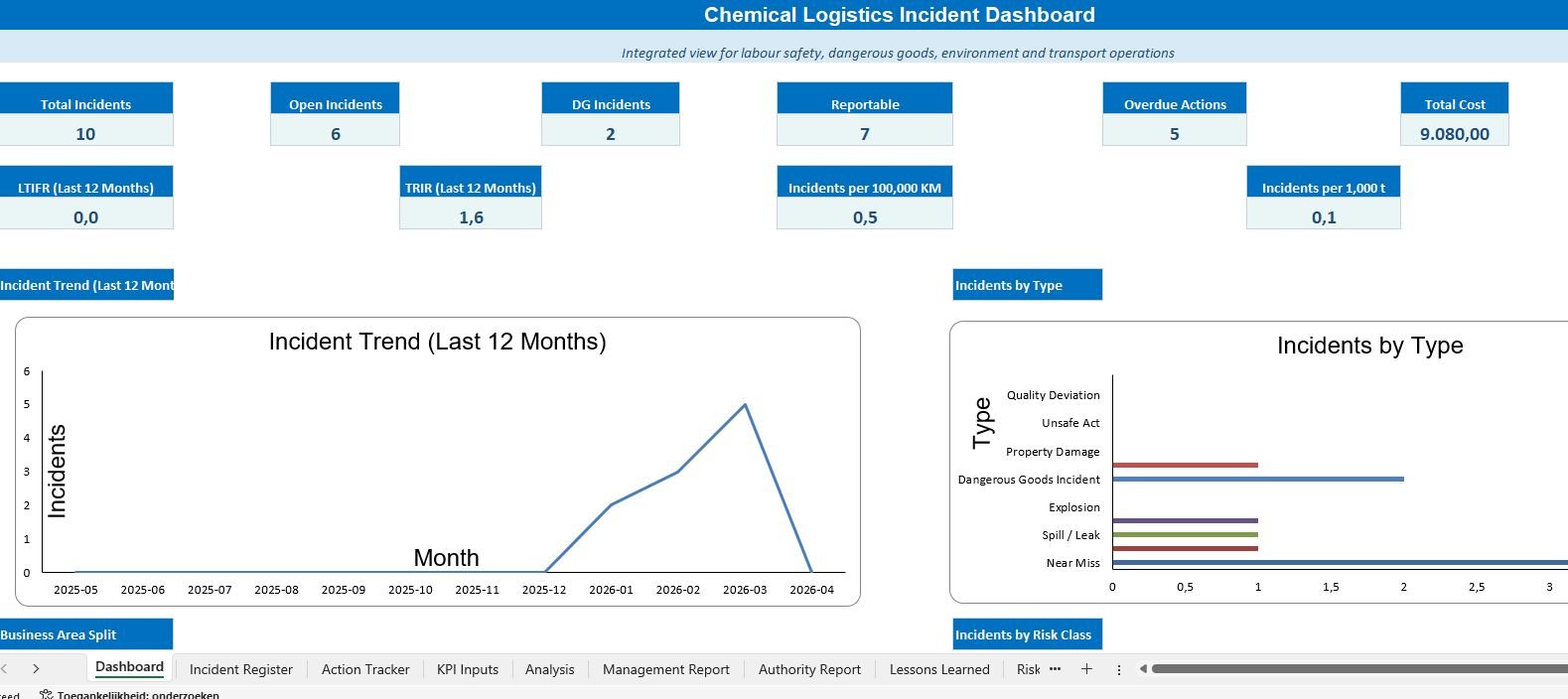 The tool includes a fully built management dashboard designed for clarity and decision-making.
It provides visual insights into:
- Incident trends over the last 12 months
- Distribution by type, location and business area
- Risk classification (Low, Medium, High, Critical)
- Open versus closed incidents
- Overdue actions
- Root cause distribution
The dashboard is designed to be clear, structured and suitable for management reporting, avoiding the clutter often seen in complex spreadsheets.
Advanced Safety KPIs based on operational exposure
A key strength of this tool is the inclusion of exposure-based safety indicators, allowing organisations to measure performance relative to operational activity.
By entering monthly data such as:
- Working hours
- Driven kilometres
- Tonnage handled
The tool automatically calculates:
- LTIFR (Last 12 Months)
- TRIR (Last 12 Months)
- Incidents per 100,000 kilometres
- Incidents per 1,000 tonnes
These indicators provide a far more accurate reflection of safety performance than simple incident counts.
Management Reporting and Compliance Support
The tool supports both internal and external reporting requirements through dedicated tabs, including:
- Management Report (ready for monthly review)
- ADR Annual Report support
- Overview of reportable incidents
- Authority notification tracking
- Lessons learned documentation
This makes the tool suitable for:
- Management reviews
- Internal audits
- External inspections
- Regulatory reporting
Designed for the chemical logistics sector
This tool has been specifically developed for organisations operating in:
- Chemical warehousing
- Tank storage terminals
- ADR transport operations
- Freight forwarding and logistics
- Dangerous goods handling and distribution
- Seveso / BRZO environments
It reflects real operational needs and regulatory expectations within these sectors.
What you receive
- A fully functional Excel-based management tool
- Pre-configured dashboard and KPI system
- Structured incident and action tracking
- Built-in classifications and dropdowns
- Example data for immediate use
- Easy to customise to your organisation
Technical specifications
- Format: Microsoft Excel (.xlsx)
- Language: English
- Compatibility: Excel 365 / Excel 2019 and newer
- Installation: Not required
- Delivery: Instant download
Related products
-

International Bacteria Exposure & Risk Database – English
€49,95 Add to basket -
Chemical Reaction and Compatibility Tool – Professional Excel Database (English) – Subcription
€89,00 Add to basket -

E-learning – Loading and unloading of chemical tank trucks (French)
€95,00 Add to basket -

Work Permit Management System (English)
€149,00 Add to basket