
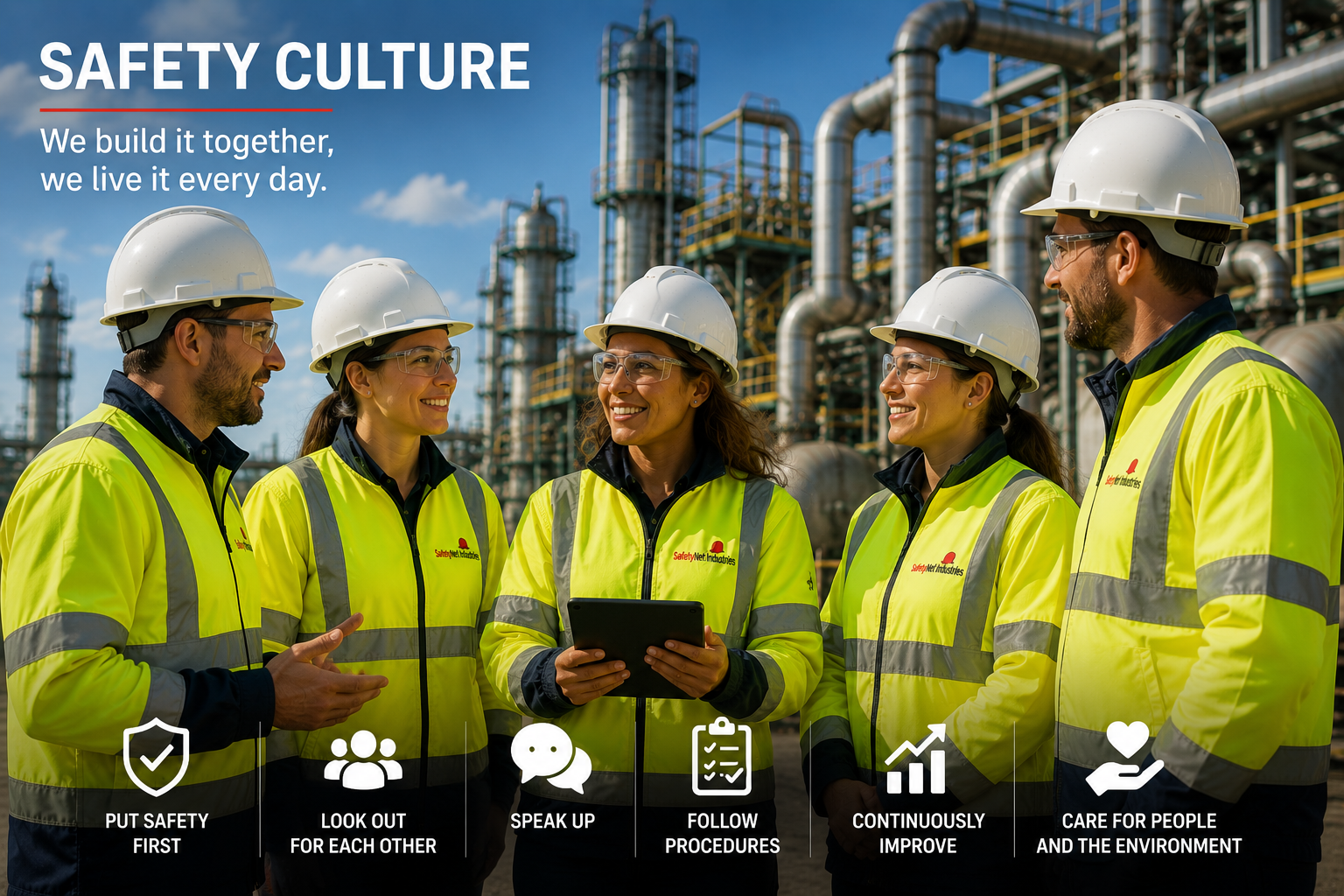
In modern industry, organizations often invest enormous amounts of money in safety procedures, personal protective equipment, technical safeguards, training systems and compliance programs. Yet serious incidents still occur in companies that appear, at least on paper, to have strong safety management systems.
Investigations into major industrial disasters repeatedly show that accidents are rarely caused by a single technical failure alone. Instead, they are often the result of organizational behavior, communication problems, leadership failures, normalization of unsafe practices and a gradual weakening of attention toward risk. In many cases, warning signs existed long before the incident occurred, but they were ignored, underestimated or accepted as “normal.”
This is where the concept of safety culture becomes critically important.
Safety culture is one of the most discussed subjects within industrial safety, occupational health, process safety and high-risk operations. It is also one of the most misunderstood. Many organizations believe safety culture simply means encouraging workers to “work safely” or promoting positive attitudes toward safety. In reality, safety culture goes much deeper. It influences how decisions are made, how risks are perceived, how managers behave under pressure and how organizations balance production, cost, efficiency and human safety.
A company may have excellent procedures and still possess a weak safety culture. Conversely, organizations with strong safety cultures often achieve better safety outcomes even in highly hazardous environments because safety becomes integrated into everyday operational thinking rather than treated as a separate compliance activity.
Today, safety culture has become a major focus in sectors such as chemical manufacturing, aviation, energy, logistics, offshore operations, pharmaceuticals, warehousing, transportation, nuclear power and heavy industry. Regulators in the United Kingdom, the United States and many European countries increasingly recognize that long-term safety performance depends not only on technical compliance but also on organizational behavior and leadership.
What Is Safety Culture?
The term “safety culture” became widely known after the 1986 Chernobyl nuclear disaster. Investigators concluded that the catastrophe was not simply caused by technical design flaws, but also by organizational attitudes, communication failures and management behavior. The International Atomic Energy Agency later described safety culture as the collection of characteristics and attitudes within organizations that establish safety as an overriding priority.
Since then, the concept has expanded into virtually every high-risk industry.
In practical terms, safety culture refers to how people within an organization think about safety, prioritize safety and behave in relation to risk.
It includes:
- leadership behavior,
- employee attitudes,
- communication patterns,
- accountability,
- trust,
- supervision,
- learning from incidents,
- and the everyday decisions people make when balancing safety against operational pressure.
Perhaps the simplest way to describe safety culture is this:
Safety culture is what people do when nobody is watching.
Organizations often display polished safety slogans, posters and procedures. However, true safety culture becomes visible during difficult situations:
- when deadlines are under pressure,
- when equipment fails,
- when production targets are threatened,
- or when workers must choose between speed and safety.
A strong safety culture means workers still choose safe behavior even when shortcuts would be easier.
Safety Culture Is Not the Same as Compliance
One of the most important misunderstandings surrounding safety culture is the belief that compliance automatically creates safety.
Compliance is important. Laws, standards and procedures provide essential structure. However, organizations can comply with regulations while still operating unsafely.
Many major industrial accidents occurred in companies that formally complied with legal requirements. Procedures existed. Documentation existed. Training records existed. Yet unsafe behaviors and organizational weaknesses continued underneath the surface.
This happens because compliance often focuses on whether systems exist, while safety culture focuses on how people actually behave.
For example, a company may have:
- a permit-to-work system,
- confined space procedures,
- work-at-height training,
- and risk assessments,
yet workers may still:
- bypass isolation procedures,
- ignore alarms,
- avoid reporting near misses,
- or feel pressured to continue unsafe work.
In weak safety cultures, procedures become paperwork exercises rather than living operational controls.
In strong safety cultures, procedures are respected because people genuinely believe they protect lives.
Why Safety Culture Became So Important
Several major industrial disasters fundamentally changed how organizations view safety culture.
The Piper Alpha offshore disaster in 1988 demonstrated how communication failures and permit-to-work weaknesses could escalate into catastrophe.
The Texas City refinery explosion in 2005 showed how cost pressure, organizational complacency and deteriorating process safety awareness could lead to massive loss of life.
The Deepwater Horizon disaster in 2010 highlighted failures in risk management, decision-making and safety leadership under operational pressure.
Again and again, investigations revealed similar themes:
- warning signs ignored,
- normalization of deviation,
- production pressure overriding safety,
- poor communication,
- weak learning systems,
- and management disconnected from operational realities.
As a result, regulators increasingly recognized that technical systems alone cannot prevent major accidents.
This led to growing emphasis on:
- leadership involvement,
- worker engagement,
- behavioral safety,
- reporting culture,
- and organizational learning.
The Human Side of Safety
At its core, safety culture is about people.
Humans make decisions continuously throughout the working day. Some decisions are conscious. Others are automatic habits shaped by organizational norms.
Workers observe how managers behave. They notice whether supervisors prioritize production over safety. They notice whether unsafe behavior is tolerated. They notice whether reporting problems creates blame or support.
Over time, these experiences shape collective behavior.
If workers believe management only cares about productivity, safety procedures gradually lose importance.
If employees fear punishment for reporting mistakes, incidents become hidden.
If shortcuts are rewarded because they improve speed, unsafe practices slowly become normalized.
This normalization process is particularly dangerous.
Small deviations from procedure may initially appear harmless. Because no incident occurs, workers gradually accept the behavior as normal. Over months or years, risk exposure increases until eventually a serious accident occurs.
Strong safety cultures actively resist this process by continuously reinforcing standards, encouraging communication and maintaining visible leadership involvement.
Leadership and Safety Culture
Leadership is perhaps the single most important factor influencing safety culture.
Employees pay close attention to what leaders truly prioritize. Official safety statements matter far less than visible behavior.
For example:
- Do managers stop unsafe work?
- Do supervisors wear PPE correctly?
- Do leaders investigate near misses seriously?
- Do production targets override safety concerns?
- Are workers listened to when they raise risks?
In organizations with poor safety cultures, leaders often unintentionally send conflicting messages. Safety may be described as the “highest priority,” yet employees are rewarded primarily for productivity, speed and cost reduction.
Workers quickly recognize these contradictions.
Strong safety leaders understand that culture is created through consistency. They demonstrate through actions that safety genuinely matters, especially during operational pressure.
Effective safety leadership also requires visibility. Leaders who remain disconnected from operational environments often fail to understand real workplace risks.
This is why many organizations now emphasize:
- safety walks,
- frontline engagement,
- visible field presence,
- and open communication.
Trust and Psychological Safety
An essential element of safety culture is trust.
Workers must feel safe to:
- report mistakes,
- raise concerns,
- stop unsafe work,
- and discuss near misses honestly.
This concept is often called psychological safety.
In weak safety cultures, employees may fear blame, punishment or negative career consequences if they speak openly about risks.
As a result:
- incidents go unreported,
- unsafe conditions remain hidden,
- and organizations lose opportunities to learn.
Strong safety cultures create environments where reporting is encouraged rather than punished.
This does not mean organizations ignore accountability. Reckless behavior still requires consequences. However, most errors result from system weaknesses, operational pressure or human limitations rather than deliberate misconduct.
Organizations with mature safety cultures focus on learning rather than blame.
Safety Culture in Different Countries
Safety culture is influenced not only by companies, but also by national industrial traditions and regulatory philosophies.
The United Kingdom strongly emphasizes risk assessment, management accountability and workforce involvement. British regulators increasingly evaluate organizational culture alongside technical compliance.
The United States often combines strong technical regulation with highly variable workplace cultures due to the diversity of industries and contractor structures. Some American companies possess world-class safety cultures, while others remain heavily production-driven.
Germany traditionally integrates safety deeply into engineering discipline, vocational training and operational planning. German industrial culture often emphasizes procedural consistency and technical rigor.
In Scandinavian countries, organizational trust and worker participation frequently play particularly strong roles in safety management.
Southern European countries sometimes face greater challenges related to subcontracting, temporary labor and economic pressure, which can influence consistency of safety culture implementation.
However, regardless of national differences, the strongest organizations across all countries typically share common cultural characteristics.
Characteristics of Strong Safety Cultures
Organizations with strong safety cultures usually demonstrate several recognizable patterns.
Safety is integrated into operational decision-making rather than treated separately from production.
Workers feel comfortable reporting hazards and stopping unsafe work.
Near misses are treated as learning opportunities.
Supervisors actively coach safe behavior rather than only enforcing rules after violations occur.
Leaders remain visible and engaged with frontline operations.
Training focuses on competence rather than paperwork completion.
Procedures are realistic and practical instead of excessively bureaucratic.
Contractors are managed with the same safety expectations as employees.
Incidents are investigated deeply to identify organizational causes rather than only blaming individuals.
Most importantly, strong safety cultures maintain attention toward risk even during routine operations and production pressure.
Weak Safety Culture Warning Signs
Weak safety cultures often display recognizable symptoms long before major incidents occur.
Common warning signs include:
- repeated minor incidents,
- normalization of shortcuts,
- underreporting of near misses,
- poor housekeeping,
- weak supervision,
- blame-oriented investigations,
- excessive production pressure,
- and disconnected leadership.
Another major warning sign is procedural drift. Over time, organizations may gradually move away from formal procedures because workers believe alternative methods are “faster” or “more practical.”
This drift often occurs slowly and invisibly until a serious event exposes the accumulated weaknesses.
Weak safety cultures also frequently rely too heavily on paperwork. Procedures exist formally, but they are not genuinely followed or understood operationally.
Safety Culture and Major Hazard Industries
Safety culture is especially critical within high-risk industries such as:
- chemical processing,
- oil and gas,
- aviation,
- nuclear energy,
- logistics involving dangerous goods,
- pharmaceuticals,
- mining,
- and heavy manufacturing.
In these sectors, failures can produce catastrophic consequences affecting workers, communities and the environment.
This has led regulators increasingly to examine organizational culture during inspections and accident investigations.
In Europe, Seveso legislation concerning major accident hazards increasingly recognizes the importance of management systems and organizational control.
In the United States, OSHA and the Chemical Safety Board frequently identify cultural and organizational weaknesses during investigations.
The aviation industry perhaps provides one of the strongest examples of mature safety culture development. Aviation safety improved dramatically after organizations began encouraging open reporting, non-punitive learning systems and crew resource management.
Many industrial sectors now attempt to apply similar principles.
Measuring Safety Culture
One challenge is that safety culture cannot easily be measured through simple statistics alone.
Low injury rates do not automatically mean strong safety culture exists. Some organizations underreport incidents or simply experience good luck for extended periods.
As a result, companies increasingly use broader indicators such as:
- near miss reporting,
- employee surveys,
- safety observations,
- leadership engagement,
- audit findings,
- training effectiveness,
- and reporting openness.
However, measuring culture remains difficult because it involves attitudes, trust and behavior rather than purely technical data.
Many organizations therefore combine quantitative metrics with qualitative assessments and workforce feedback.
The Future of Safety Culture
Safety culture continues evolving as industries change.
Digitalization, remote operations, artificial intelligence and automation are transforming industrial work environments.
At the same time, organizations face:
- labor shortages,
- aging workforces,
- increasing contractor use,
- and growing operational complexity.
These trends create new cultural challenges.
For example, remote supervision may reduce direct interaction between leaders and workers. Increasing subcontracting may weaken organizational cohesion. Productivity pressure from global competition may challenge safety priorities.
However, technology may also strengthen safety culture through:
- real-time reporting systems,
- wearable monitoring,
- predictive analytics,
- digital permit systems,
- and improved communication tools.
Still, technology cannot replace leadership, trust and human accountability.
Ultimately, safety culture remains fundamentally about organizational values and behavior.
Conclusion
Safety culture is far more than a slogan or management initiative. It is the invisible system of beliefs, behaviors and priorities that determines how organizations actually manage risk in daily operations.
Procedures, regulations and technical safeguards are essential, but they are not enough on their own. Serious accidents often occur not because organizations lack rules, but because unsafe behaviors, production pressure and organizational complacency gradually weaken operational discipline.
A strong safety culture exists when people consistently prioritize safety even under pressure, when workers feel comfortable speaking openly about risks and when leadership demonstrates through actions that human life matters more than short-term operational goals.
Across the United Kingdom, the United States and Europe, regulators increasingly recognize that long-term safety performance depends as much on organizational behavior as on technical compliance.
The most successful organizations understand that safety culture is never fully complete. It requires continuous attention, visible leadership, honest communication and ongoing learning.
In the end, safety culture determines whether procedures remain words on paper or become real operational behavior that protects people from harm.
And in high-risk industries, that difference can determine whether workers return home safely at the end of the day.