
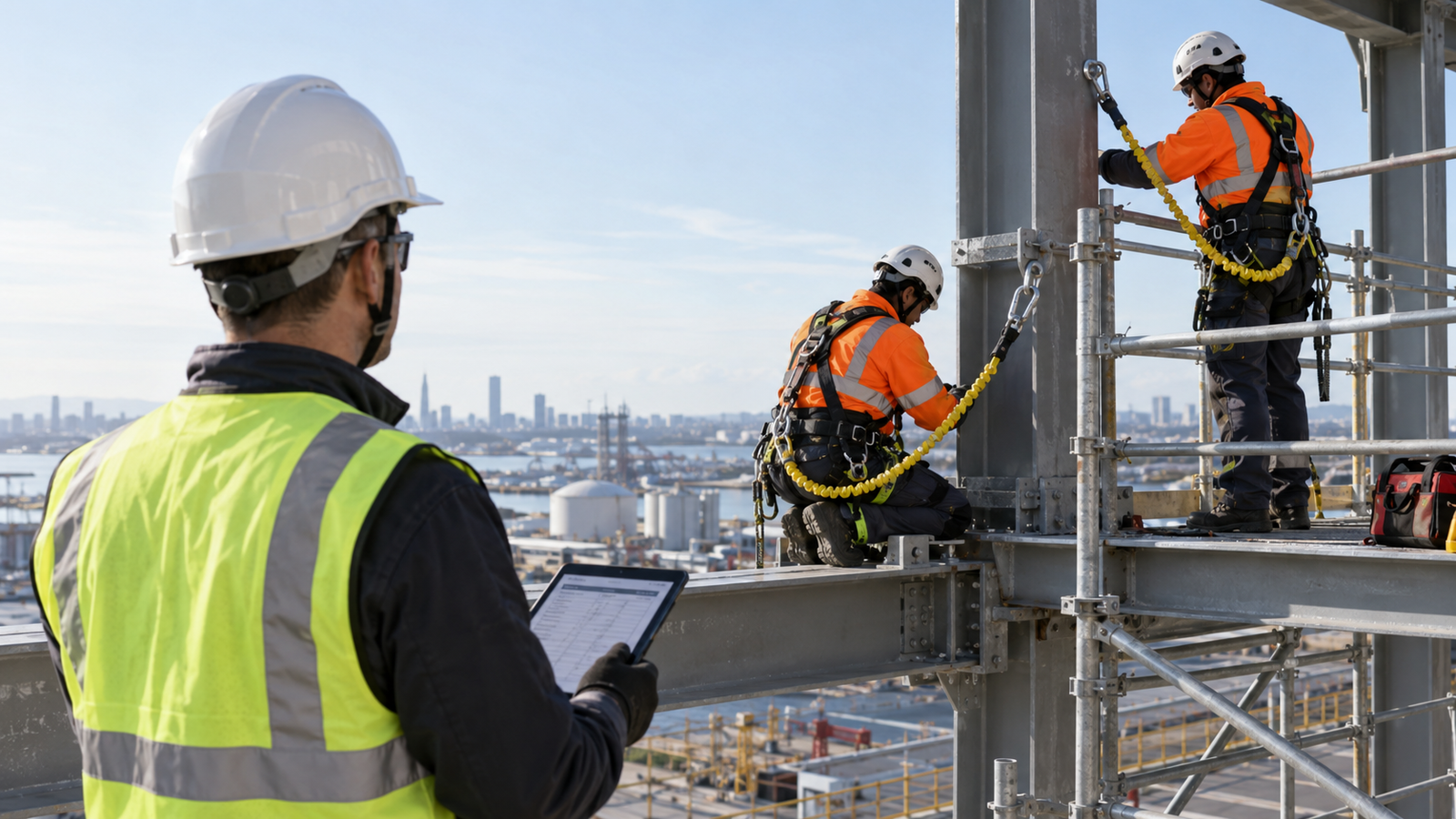
Working at height remains one of the most significant safety challenges across construction, maintenance, logistics, manufacturing, energy and industrial operations. A relatively simple task can become a serious accident scenario when it is performed several metres above ground level, close to an unprotected edge or from equipment that is not suitable for the work being carried out.
Falls are not the only concern. Tools or materials can fall onto people below, access equipment can become unstable, workers can be struck while using mobile elevating work platforms, fragile surfaces can collapse and a person suspended in a fall-arrest harness may require immediate rescue. Effective risk assessment must therefore consider working at height as a collection of credible accident scenarios rather than simply identifying “fall from height” as a single generic hazard.
A strong risk assessment asks three fundamental questions: what can go wrong, what could the consequences be, and which controls are necessary to prevent the scenario or reduce its consequences? For working at height, answering these questions properly requires considerably more detail than is often found in standard workplace risk assessments.
Understanding what working at height really means
Working at height should not automatically be associated only with roofs, scaffolding or very high structures. A serious fall can occur from relatively modest heights. Loading docks, trailers, tankers, machinery, temporary platforms, ladders, mezzanine floors, racking systems and excavations can all create situations where a person may fall from one level to another.
The first step in the risk assessment is therefore to identify where height-related exposure exists within the activity. This includes the normal work location but also access and egress. A maintenance technician may have a safe working platform once the destination has been reached, while the route used to reach that platform presents the greatest risk.
The assessment should also examine how frequently the task is performed, how long workers are exposed and whether the circumstances change between individual jobs. A task carried out every day under controlled conditions presents a different risk profile from an infrequent maintenance activity performed during a shutdown when equipment, contractors and temporary installations are present simultaneously.
Moving from hazards to credible accident scenarios
One of the weaknesses of traditional risk assessments is that hazards are sometimes described too broadly. An entry such as “working at height – risk of falling – use fall protection” provides little information about how an accident could actually develop.
Scenario-based analysis provides a more useful approach. Consider a technician performing maintenance on a roof. Several independent scenarios may exist. The worker could fall from an unprotected roof edge, fall through a fragile roof panel, slip while walking across a wet surface or fall while transferring from an access ladder onto the roof. A fall-arrest system may stop the fall but subsequently leave the worker suspended and unable to self-rescue.
Each scenario has different causes and may require different controls.
The same principle applies to ladders. A ladder can slide because it has not been secured, a worker can overreach and lose balance, the ladder can be positioned on an uneven surface or a person can attempt to carry tools while climbing. Simply recording “ladder – fall hazard” combines several fundamentally different failure mechanisms into one line of a risk assessment.
Breaking activities down into realistic scenarios makes it easier to identify appropriate preventive and mitigating measures.
The hierarchy of controls must remain central
A common mistake in working-at-height safety is to begin the assessment by selecting personal fall protection. Harnesses, lanyards and fall-arrest devices are important safety equipment, but they should not automatically be the first solution.
The preferred approach is to avoid working at height where reasonably practicable. Some inspection tasks, for example, can be performed using permanently installed monitoring equipment, cameras, remote inspection technologies or equipment that can be lowered to ground level for maintenance.
Where work at height cannot be avoided, collective protection should normally be considered before personal protection. Permanent platforms, guardrails, suitable scaffolding and properly designed temporary working platforms can protect workers without requiring continuous individual action.
Only where residual fall exposure remains should restraint or fall-arrest systems become a central part of the control strategy. Even then, the assessment cannot end with the instruction to “wear a harness”. Anchorage, compatibility of equipment, required fall clearance, swing-fall potential, inspection, user competence and rescue arrangements all need consideration.
A fall-arrest system does not prevent a fall. It limits its consequences.
Environmental and operational conditions matter
Risk assessments should also reflect the environment in which the work is performed. Wind, rain, ice, heat, poor lighting and contamination of walking surfaces can significantly change the probability of an accident.
Industrial environments introduce additional hazards. Workers at height may be exposed to moving cranes, process equipment, electrical installations, hot surfaces, hazardous substances or vehicle movements below their workplace. A mobile elevating work platform used inside a warehouse, for example, may create collision risks with forklifts as well as crushing hazards between the platform and overhead structures.
Simultaneous operations are particularly important. Contractors installing pipework above a production area may create falling-object risks for employees below. Maintenance activities on a loading rack can interfere with tanker movements. Roof work may take place close to exhaust systems or process vents.
For this reason, working-at-height risk assessment should be connected to permit-to-work systems, contractor management, isolation procedures and site traffic management where applicable.
Human factors and changing conditions
Technical controls alone cannot eliminate every working-at-height accident. Human factors frequently influence whether an existing control remains effective.
Time pressure can encourage workers to use a ladder instead of obtaining the correct access equipment. Familiarity with a task can gradually reduce risk perception. Workers may disconnect a lanyard temporarily because an anchor arrangement makes movement difficult. Equipment can also be used outside its intended purpose because the correct equipment is located elsewhere on the site.
Competence must therefore be assessed in relation to the actual task and equipment. Training in the general principles of working at height does not automatically demonstrate competence to erect scaffolding, operate a mobile elevating work platform or use complex fall-arrest systems.
Risk assessments should also recognize that conditions can change after work has started. Weather can deteriorate, barriers can be removed, equipment can be repositioned and other contractors can enter the area. Dynamic risk assessment and effective supervision are consequently important additions to the formal pre-job assessment.
Rescue planning is part of the risk assessment
One of the most frequently underestimated aspects of fall protection is rescue. Where fall-arrest equipment is used, the organization must consider what happens after the equipment successfully arrests a fall.
A suspended worker may be injured, unconscious or unable to return to a safe position without assistance. A rescue plan that depends entirely on calling the public emergency services may not provide a sufficiently rapid or task-specific response.
The assessment should therefore consider rescue access, suitable rescue equipment, trained personnel, communication arrangements and foreseeable complications. Rescue itself can expose additional employees to height hazards, which means that the rescue method must also be risk assessed.
Emergency arrangements should correspond to the actual scenario. Rescuing someone suspended below a roof edge is fundamentally different from recovering a person from a mobile elevating work platform or industrial structure.
Building a stronger scenario-based risk assessment
Organizations managing multiple locations or large numbers of height-related activities often face another problem: consistency. Different assessors may identify different scenarios for essentially identical activities. Important hazards can consequently disappear from assessments simply because an individual assessor did not consider them.
A structured scenario library can help address this weakness.
The SafetyNet Labs Working at Height Scenario & Risk Database has been developed as a practical resource for organizations that want to strengthen and standardize their working-at-height risk assessments. Rather than relying solely on generic hazard descriptions, the database provides structured accident and failure scenarios that can be used as input for task risk assessments, workplace risk inventories, audits, safety reviews and control verification.
The database can help safety professionals consider scenarios involving access equipment, ladders, scaffolds, roofs, platforms, falling objects, fall-protection systems, environmental conditions, human factors and other relevant working-at-height situations. It is particularly useful as a reference source when developing or reviewing an organization’s own risk register.
The objective is not to replace professional judgement or site-specific assessment. A database cannot know the exact configuration of a workplace, the competence of individual employees or the condition of equipment on a particular day. Its value lies in providing a systematic starting point and reducing the likelihood that credible scenarios are overlooked.
For organizations operating multiple sites, this also supports greater consistency. A maintenance activity in one facility should not receive a fundamentally different level of risk analysis simply because another assessor prepared the assessment.
Risk assessment should remain a living process
A working-at-height risk assessment should never become a document that is completed once and then stored indefinitely. Changes to equipment, buildings, processes, access arrangements and work methods can introduce new scenarios or make existing controls ineffective.
Near misses and incidents should also feed back into the assessment process. If a tool falls from a platform without causing injury, the absence of injury does not mean that the controls were adequate. The event provides evidence that a credible accident scenario exists and that barriers should be reviewed.
The most effective organizations therefore treat risk assessment as an ongoing process of identifying scenarios, implementing controls, verifying their effectiveness and learning from operational experience.
Working at height can never be made safe simply by adding a harness or completing a checklist. Effective control begins with understanding exactly how an accident could occur. By combining competent assessment, the hierarchy of controls, realistic accident scenarios, human-factor considerations and robust rescue planning, organizations can transform working-at-height risk assessment from a compliance exercise into a practical tool for preventing serious injuries and fatalities.
The SafetyNet Labs Working at Height Scenario & Risk Database supports this approach by giving safety professionals a structured foundation from which to identify, evaluate and manage credible working-at-height scenarios across their operations.